The global construction industry is undergoing a rapid transformation toward higher safety standards, greater efficiency, and more sustainable practices, which has reshaped the market share and application scope of different scaffolding types. As of 2026, modular prefabricated scaffolding systems have overtaken traditional non-standard scaffolding to become the most widely used solution in mainstream construction projects, dominating the market with their irreplaceable advantages.
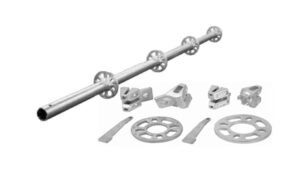
Among all modular systems, cuplock and ringlock (disk lock) scaffolding account for the largest market share, with a penetration rate exceeding 67% in new construction projects globally. This type of scaffolding uses standardized prefabricated components and mature locking mechanisms, bringing revolutionary improvements to construction efficiency. Unlike traditional fastener-type scaffolding that requires on-site assembly of scattered parts, modular disk lock scaffolding can be erected 30% faster on large-scale projects such as high-rise buildings, bridges, and industrial plants, while providing higher and more stable load-bearing capacity. Its standardized design also reduces the risk of missing parts and irregular installation, which perfectly meets the increasingly strict safety requirements of regulatory authorities around the world. For large infrastructure projects, such as highway bridges and metro stations, modular scaffolding can adapt to complex site conditions and adjust the structure flexibly, making it the first choice for main contractors.
Following modular systems, attached lifting scaffolding, also known as intelligent climbing scaffolding, has become the dominant solution for high-rise residential and commercial building construction, with a market size exceeding 10 billion US dollars in China alone and an annual compound growth rate of over 15%. This type of scaffolding is attached to the main structure of the building and can be lifted layer by layer with construction progress, eliminating the need for repeated disassembly and erection. It not only saves a lot of labor and material costs but also provides a more enclosed and safe working environment, reducing the risk of falling accidents. Driven by the development of prefabricated buildings and intelligent construction, more manufacturers have added intelligent monitoring systems to climbing scaffolding to track load and structural stability in real time, which further enhances its safety and market acceptance. For developers of high-rise projects, the green and efficient characteristics of intelligent climbing scaffolding also fit the current carbon neutrality policy orientation, making its application scope continue to expand.
Traditional scaffolding types still occupy a certain market share in specific scenarios. Fastener-type steel tube scaffolding is still widely used in small-scale civil construction and renovation projects because of its low cost and strong adaptability to irregular structures. Frame scaffolding, also known as portal scaffolding, is popular for indoor renovation and small facade work because it is light and easy to move. However, due to their lower safety and efficiency compared to modular systems, their market share has been declining year by year.
Looking forward, the construction scaffolding market will continue to concentrate towards standardized, intelligent, and service-oriented modular systems. With the continuous upgrading of construction safety regulations and the promotion of prefabricated construction, the market share of high-performance modular scaffolding and intelligent attached lifting scaffolding will further increase, becoming the absolute mainstream of the future construction market.