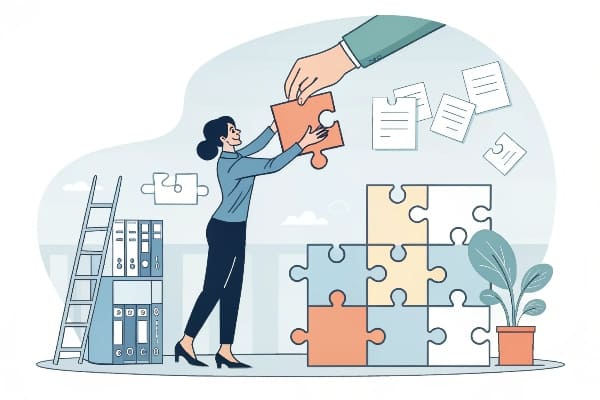
Struggling to grasp a new, complex skill at work? You feel like you're missing a key piece of the puzzle, and it's holding you back. This is where scaffolding1 comes in, providing the exact support you need to succeed.
In a learning context, "scaffolding" is a method where a teacher or mentor provides temporary support2 to help someone learn a new skill. [2] This support is gradually removed as the person becomes more competent, allowing them to eventually perform the task independently. [4, 5]
<div style="text-align: center;">
</div>
When I first started my own mold and CNC trading company, I had to train new designers constantly. I didn't have a name for it then, but I was "scaffolding" them. I was providing a framework for them to learn, building their skills piece by piece, just like we build a complex mold. I realized this method of teaching is the key to developing true experts. Let's explore how it actually works.
How Is Learning Scaffolding Like Physical Scaffolding?
The term "scaffolding" might sound like another piece of business jargon. But if you get a clear picture of what it represents, you'll see how powerful it can be. The best way to understand it is to compare it to its namesake in construction.
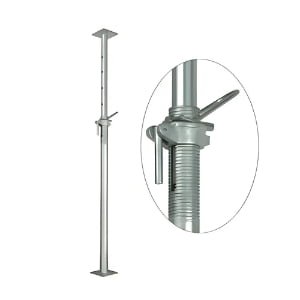
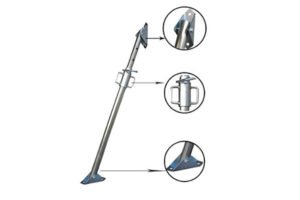
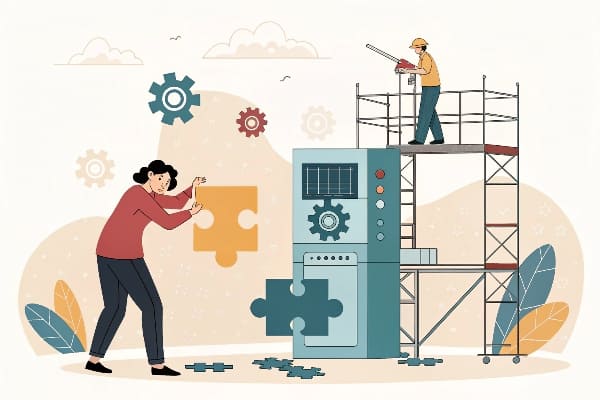
Both physical and educational scaffolding3 provide a temporary framework to support a project during its development—one for a building, the other for a person's skills. [5, 19] Both are designed to be removed once the structure, or the skill, is strong enough to stand on its own.
<div style="text-align: center;">
</div>
Diving Deeper: The Blueprint of Support
The comparison between building a structure and building a skill is surprisingly direct. In my world of mold making, you can't create a complex part without a precise, step-by-step process. The same logic applies to developing a person's abilities. Scaffolding provides that process.
Let's look at a direct comparison:
| Feature | Physical Scaffolding (Construction) | Educational Scaffolding (Learning) |
|---|---|---|
| Purpose | To provide temporary support2 and access for workers to build a permanent structure. [17, 19] | To provide temporary support for a learner to build a permanent skill or understanding. [2, 6] |
| Foundation | Must be built on solid, level ground to ensure the entire structure is stable. [21] | Starts by connecting to the learner's prior knowledge to create a stable base for new information. [2, 15] |
| Structure | A system of poles, braces, and platforms that give workers a safe way to proceed. | A system of tools like checklists, demonstrations, and guided questions that give learners a safe way to tackle a new skill. [6] |
| Adaptability | Levels are added or removed as the building grows, always staying just where workers need it. | Support is increased or decreased based on the learner's progress, always staying within their "zone of proximal development4." [11] |
| Removal | The entire structure is dismantled and taken away once the building is complete and can support itself. [14] | The support is gradually faded out until the learner is confident and can perform the skill independently. [5, 10] |
I remember teaching a young designer how to create a mold for a simple plastic cover. First, I just had him watch me do it (the "I do" phase). [2] Then, we did one together, with me guiding his every move ("We do"). Finally, after a few more tries, he was able to do it all by himself ("You do"). That's scaffolding in action.
What Are Practical Ways to "Scaffold" Someone?
You want to help a new team member, but just giving them a fish doesn't teach them how to fish. If you just give answers, they become dependent. The key is to use specific techniques that build their independence and critical thinking.
Effective scaffolding involves modeling the desired outcome, breaking down complex tasks into smaller chunks, using checklists, and asking guiding questions. [2, 15] It's an interactive process focused on building the learner's own problem-solving abilities. [12]
<div style="text-align: center;">
</div>
Diving Deeper: Your Scaffolding Toolkit
Building a person's skills requires a toolkit, just like building a mold. You wouldn't use a sledgehammer for a precision job. You need the right tools for the right stage of learning. Here are some of the most effective tools I've used to train my team:
- Show and Tell (Modeling): The most powerful tool is to simply show someone how it's done. [15] When I have a new designer, I'll often start by designing a part while they watch, explaining my thought process out loud. "Okay, I'm choosing this type of steel because the plastic is abrasive. Now, I'm adding a 1-degree draft angle here to make sure the part ejects cleanly." This "think-aloud" process reveals the logic behind the actions. [15]
- Break It Down: A complex injection mold can have hundreds of parts. It's overwhelming. So, we break it down. "This week, just focus on the cooling channels. Next week, the ejection system." Breaking a large task into manageable steps reduces anxiety and allows for focused learning on one aspect at a time. [2]
- Provide Checklists and Templates: We have checklists for everything: pre-design, mold assembly, final inspection. These aren't meant to be crutches forever. They are the "guardrails" on the scaffold. They ensure critical steps aren't missed while the learner is still focusing on the basics. Over time, the checklist becomes second nature.
- Ask Guiding Questions: This is perhaps the most important technique. Instead of saying, "Your cooling line is too close to the edge," I'll ask, "What do you think will happen to the part's temperature in that thin steel area during continuous operation?" This prompts them to think critically and discover the answer themselves, leading to much deeper and more permanent learning. [15]
Using these techniques helps your team member build their own mental model of how to work, which is far more valuable than just knowing the answer to one problem.
How Do You Know When to Remove the Scaffolding?
You've been supporting a colleague, and they're making progress. But how do you know they're ready to fly solo? If you remove the support too soon, they might fail and lose confidence. But if you wait too long, they can become dependent.
You begin to remove support when the learner shows consistent success, can identify and correct their own errors, and expresses confidence. [5] The removal should be gradual, not sudden, allowing them to take on increasing responsibility for their own learning. [10]
<div style="text-align: center;">
</div>
Diving Deeper: The Readiness Assessment
In manufacturing, a part isn't ready to ship until it passes a final inspection. Similarly, a learner isn't ready for full independence until they demonstrate certain key competencies. It's a judgment call, but there are clear signals to look for. I've always used a mental checklist to decide when to step back.
Here are the key indicators that it's time to start removing the scaffold:
- Consistency in Performance: They can complete the task correctly multiple times without your input. That young designer I mentioned earlier? When he could design three consecutive simple molds without major errors, I knew he was ready for a more complex part.
- Self-Correction: This is a huge milestone. When a learner spots their own mistake and fixes it before you even mention it, it shows they have internalized the standards of quality. They've moved from simply following instructions to actively thinking about the outcome.
- Asking Deeper Questions: Their questions change. Instead of "What do I do next?", they start asking "Why do we do it this way?" or "What if we tried this alternative approach?" This shows they are not just executing a task, but thinking strategically about the process.
- Confidence and Initiative: They begin a task without waiting for instruction. They might even start helping newer members of the team. When I saw my designer showing an intern how to calculate a shrinkage rate, I knew my scaffolding work was done. He was now ready to become a scaffolder himself.
The goal isn't just to remove support, but to foster a confident, independent professional who can solve problems on their own.
Conclusion
Scaffolding is more than a teaching tactic; it's a philosophy of empowerment5. It's the framework we use to build not just products, but people. By providing the right support at the right time, we help them reach new heights of skill and confidence.
Understanding scaffolding can enhance your teaching methods and improve learner outcomes. ↩
Explore how temporary support can facilitate effective learning and skill acquisition. ↩
Discover the advantages of educational scaffolding for both learners and educators. ↩
Understanding this concept can help tailor support to individual learner needs. ↩
Explore how empowerment can transform teaching and learning experiences. ↩