Introduction
Walk onto any active construction site, and you will spot it almost immediately: scaffolding. It is the temporary backbone that keeps workers safe, productive, and within reach of the job at hand-4. In simple terms, scaffolding is a temporary structure built to support workers, tools, and materials during construction, maintenance, or repair work at height-4. Whether it is painting a warehouse ceiling, plastering an exterior wall, or installing ductwork in a factory, scaffolding makes all of that possible-4.
This guide provides a comprehensive overview of scaffold types, applications, and the latest safety standards for 2026.
What Is Scaffolding and Why Does It Matter?
Scaffolding is a temporary structural framework designed to provide elevated support and access during various phases of work. It consists of interconnected components arranged to ensure stability, safety, and ease of movement-11. The structure’s height and configuration can be adjusted to meet different requirements, facilitating efficient work at multiple levels-11.
Scaffolding matters because productivity and safety on site depend on it. A stable platform means tradespeople can focus on the job instead of worrying about balance or reach. For contractors juggling tight deadlines and strict Occupational Health and Safety (OHS) compliance, the right scaffold system is not a luxury—it is a core part of project planning that directly affects timelines, labour costs, and the safety record of every site-4.
The global scaffolding market size was valued at approximately 59.63billionin2025andisprojectedtoreach59.63billionin2025andisprojectedtoreach80.49 billion by 2030, at a compound annual growth rate (CAGR) of 6.1%-11. This growth is driven by rapid urbanization, increasing demand for high-rise construction, and the rising adoption of temporary access solutions across industrial infrastructure projects-11.
Core Components of a Scaffolding System
A scaffold is only as good as the parts that hold it together. While designs vary, most systems share a common set of components-4:
-
Standards (vertical tubes) – carry the load down to the ground
-
Ledgers and transoms – horizontal members that tie the structure together and support platforms
-
Cross braces (diagonal bracing) – stop the frame from racking sideways
-
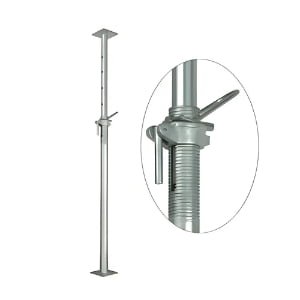
Base jacks – adjustable feet that level the scaffold on uneven ground
-
Adjustable castors – wheels for mobile towers that need to be repositioned quickly
-
Access ladders – provide safe entry and exit between platform levels
-
Guardrails – protect workers from falls on elevated platforms
Major Types of Scaffolding Systems in 2026
The construction industry in 2026 has moved decisively toward modular system scaffolding, which emphasizes quick setup and solid load-handling capabilities over traditional time-consuming methods-5. Below are the most widely used scaffolding types.
1. Cuplock Scaffolding
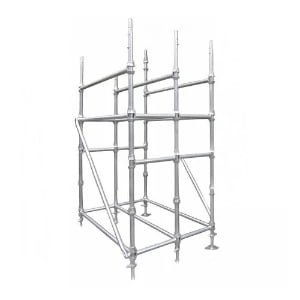
Cuplock scaffolding remains a top pick for concrete flatwork and basic access work. Its distinguishing feature is a special locking node where four horizontal members can be locked in a single motion using a top cup, eliminating loose nuts and bolts completely-5. Cuplock excels in heavy-load applications such as supporting wet concrete pours and bridge decking.
Best for: Concrete flatwork, bridge projects, heavy-duty straight-form applications, and projects where fast setup for straight configurations matters-5.
2. Ringlock Scaffolding
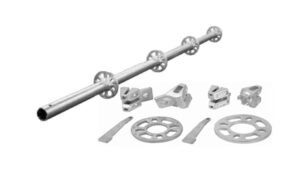
Ringlock scaffolding is widely regarded as the most adaptable and versatile system on the market today. It features a rosette connector that allows up to eight connections at a single node point, enabling the system to handle complex angles and curved building contours without sacrificing strength-5. The ability to lock ledgers and transoms simultaneously creates frame-like rigidity that outperforms earlier scaffolding systems.
Best for: Heavy industrial projects, falsework (shoring), facade construction, and any project where safety and complex geometry are paramount-5.
3. Frame Scaffolding (H-Frame / Door Frame)
Frame scaffolding, also known as ready-made or prefabricated scaffolding, consists of pre-assembled vertical frames connected by cross braces. This configuration goes up extremely fast on straight vertical walls-5. The system is lightweight, easy to relocate, and highly cost-effective for short-term projects.
Best for: Straight-facade work, exterior renovations, plastering, painting, and short-duration residential or commercial tasks where quick setup is essential.
4. Coupler-type Steel Pipe Scaffolding
Coupler-type steel pipe scaffolding is currently the most widely used type in construction globally. Composed of steel pipes connected by various couplers, this system can be adapted to virtually any building shape and height-3. Its core advantage is the ability to flexibly adjust the erection layout according to irregular site conditions.
Best for: High-rise residential and office buildings, irregular-shaped structures, old building renovations, and projects requiring frequent layout adjustments-3.
5. Suspended Scaffolding (Swing Stage)
Suspended scaffolding hangs from an overhead structure using ropes or cables, rather than resting on the ground. The two-point adjustable suspension scaffold (commonly called a swing stage) is the most frequently used type, consisting of a work platform suspended by two support ropes from outrigger beams mounted on a roof or upper building level-38.
Best for: High-rise window cleaning, facade painting, exterior building repairs, and skyscraper maintenance where ground-based support is impossible-13.
6. Mobile Scaffolding (Rolling Towers)
Mobile scaffolding incorporates castors (wheels) into the base, enabling the entire structure to be repositioned quickly without disassembly. This type is ideal for indoor work that requires frequent movement along long walls or across large floor areas.
Best for: Indoor maintenance, warehouse racking installation, ceiling work, and any task requiring frequent repositioning across a large horizontal area.
Materials: Steel vs. Aluminium
Steel scaffolding delivers superior load capacity and long-term stability for heavy-duty projects. Its high strength-to-weight ratio makes it ideal for supporting heavy materials and equipment at significant heights-4.
Aluminium scaffolding offers lightweight, mobile solutions ideal for indoor work and frequent repositioning. Although it has lower load-bearing capacity than steel, its portability and corrosion resistance make it the preferred choice for maintenance and light-duty applications where steel would be unnecessarily heavy and cumbersome-4.
Key Selection Criteria for 2026
When choosing the right scaffolding system for a project in 2026, consider the following factors-3-5:
-
Project height – Higher elevations require systems with robust stability features like Ringlock or coupler-type systems
-
Load requirements – Heavy concrete pours call for Cuplock; light maintenance tasks suit aluminium frame scaffolding
-
Site shape and access – Irregular contours or curved facades demand adaptable systems like Ringlock or tube-and-coupler
-
Construction timeline – Tight deadlines favour modular systems with erection speeds 40% faster than traditional methods-3
-
Budget – Frame scaffolding offers the lowest upfront cost for simple straight-wall projects
-
Safety compliance – Ensure all systems meet applicable OSHA or ANSI standards for the jurisdiction
Safety Standards for Scaffolding in 2026
Safety standards for scaffolding in 2026 have evolved significantly, with multiple regulatory bodies introducing updated requirements and new guidance documents.
OSHA Standards (United States)
OSHA’s scaffolding regulations are contained in 29 CFR 1926 Subpart L, covering everything from load capacity to fall protection requirements. Key provisions for 2026 include:
-
Design by qualified person – Scaffolds must be designed by a qualified person and constructed and loaded in accordance with that design-30
-
Fall protection trigger – Fall protection is required when the working platform is more than 10 feet (3.1 m) above the next lower level. Note that this is higher than the general construction trigger of 6 feet because the scaffold standard is the controlling regulation-36
-
Guardrail requirements – Top rail must be between 38 and 45 inches above the platform, mid-rail at approximately half that height, and top rail must withstand 200 pounds of force applied in any direction-36
-
Load capacity – Scaffolds must be capable of supporting at least four times the maximum intended load (safety factor of 4)-54
-
Competent person requirement – A competent person must inspect scaffolds before each work shift and after any event that could affect stability-36
ANSI Standards
ANSI/ASSP A10.8-2011 establishes safety requirements for the construction, operation, maintenance, and use of scaffolds in building and structure projects–. While OSHA’s rules are mandatory by law, ANSI standards go further by providing detailed engineering specifications, component testing protocols, and safe assembly and dismantling procedures-54.
A significant new standard took effect on 1 May 2026: ANSI/SAIA A11.6-2025, which outlines detailed methods for evaluating the performance of manufactured scaffold boards and decking products used in temporary works applications. This standard is expected to enhance safety and consistency across the scaffolding, shoring, and formwork sectors in the United States-21.
International Updates
-
Australia – Workplace Health and Safety Queensland (WHSQ) released a revised guidance document in February 2026 stating that step heights used for access and egress should not exceed 300 mm (approximately 12 inches) so far as is reasonably practicable. This represents a significant strengthening of the regulator’s position-22.
-
Canada – Federal regulations require every scaffold to be capable of supporting at least four times the likely imposed load, with platforms at least 480 mm (approx. 19 inches) wide and securely fastened in place. Guardrails are generally required at 3 metres (10 feet)–-36.
Suspended Scaffolding Safety Highlights
Suspended scaffolds are among the most hazardous types of scaffolding in use. OSHA requires suspended scaffolds to have:
-
Both guardrails and personal fall arrest systems – Guardrails on all open sides and ends, plus full-body harnesses attached to independent lifelines separate from the scaffold suspension ropes-38
-
Proper tie-backs – Tiebacks must be equivalent in strength to the hoisting rope-72
-
Secure counterweights – Counterweights must be secured by mechanical means to outrigger beams to prevent accidental displacement-72
-
Four-times load capacity – All suspension support devices must support at least four times the load or 1.5 times the load at stall capacity, whichever is greater-72
Common Safety Violations in 2026
OSHA’s scaffolding standard consistently ranks among the top five most-cited violations each year-36. The most common violations observed in inspections include:
-
Missing guardrails – Guardrails removed during work activities and not replaced promptly, especially during material loading operations-36
-
Inadequate fall protection – Failure to provide guardrails or personal fall arrest systems on platforms exceeding 10 feet in height
-
Improper access – Using cross-bracing as a climbing method instead of providing proper ladders or stair towers
-
Unstable base support – Scaffolds erected on uneven or soft ground without proper base plates or mud sills
-
Overloading – Exceeding the manufacturer’s rated load capacity, leading to structural failure risks
-
Insufficient tying and bracing – Scaffolds not adequately tied to the building structure at proper intervals
Future Trends in Scaffolding Technology
The scaffolding industry is experiencing rapid technological transformation. Key trends shaping the 2026–2030 period include:
-
Smart scaffolding management systems – Deployment of automated monitoring systems that track structural integrity in real time-11
-
AI-based safety monitoring – Artificial intelligence systems that identify safety compliance gaps before workers are at height-36
-
IoT-enabled structural analytics – Internet of Things sensors embedded in scaffold components to detect load variations and structural stress-11
-
Lightweight and sustainable materials – Development of advanced lightweight composite materials that combine strength with reduced weight and environmental impact-11
-
Modular and automated assembly – Expansion of pre-engineered modular systems that reduce onsite labour requirements and accelerate erection timelines-11
Conclusion
Selecting the right scaffolding system in 2026 requires careful evaluation of project-specific requirements including height, load demands, site configuration, timeline, budget, and regulatory compliance. The industry has decisively moved toward modular systems like Ringlock and Cuplock, which offer superior speed, strength, and versatility compared to traditional methods.
Equally important is strict adherence to the latest safety standards. With OSHA regulations mandating fall protection at 10 feet, guardrails on all open sides, four-times load capacity, and daily competent-person inspections, safety remains the cornerstone of any successful scaffolding operation. The effective date of new standards such as ANSI/SAIA A11.6 for scaffold boards (1 May 2026) marks a continued global push toward harmonized safety benchmarks in access systems-21-54.
Whether you are a professional contractor, site manager, or trade professional, understanding the types, uses, and safety essentials of scaffolding is not just about compliance—it is about protecting lives and ensuring every project is completed safely and efficiently.