Types And Applications Of Steel Formwork In Construction
Construction steel formwork is a high-strength, reusable steel formwork system used for concrete casting and shaping.
Through precise modular design, it provides reliable concrete forming solutions for various construction projects, ensuring that the cast concrete components have accurate dimensions, fixed structural contours, and a smooth and aesthetically pleasing surface.
Main Types and Uses:
Classified by project type: Primarily divided into building (housing construction) steel formwork and bridge steel formwork.
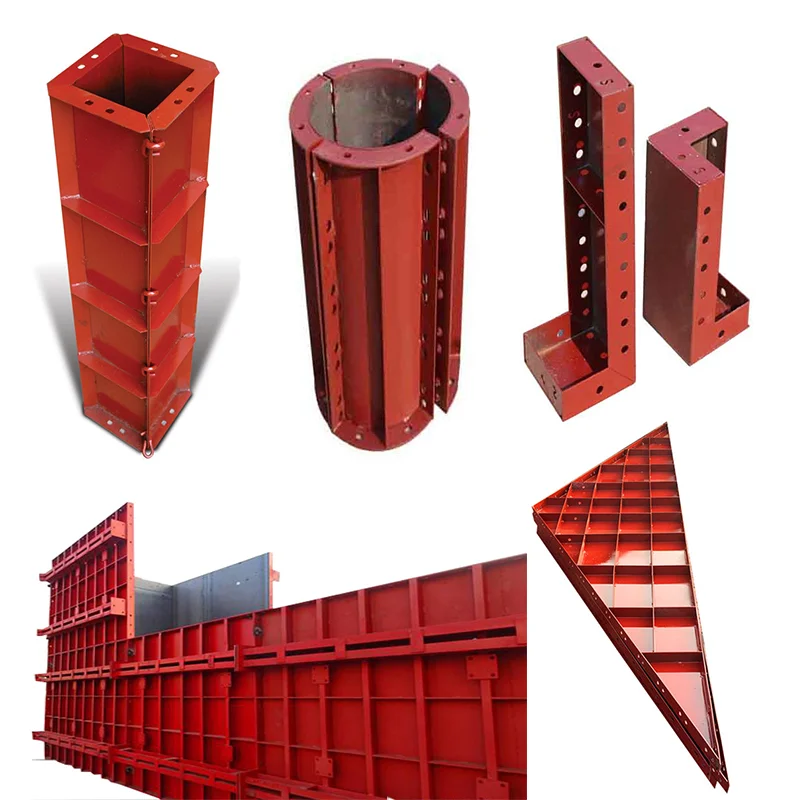
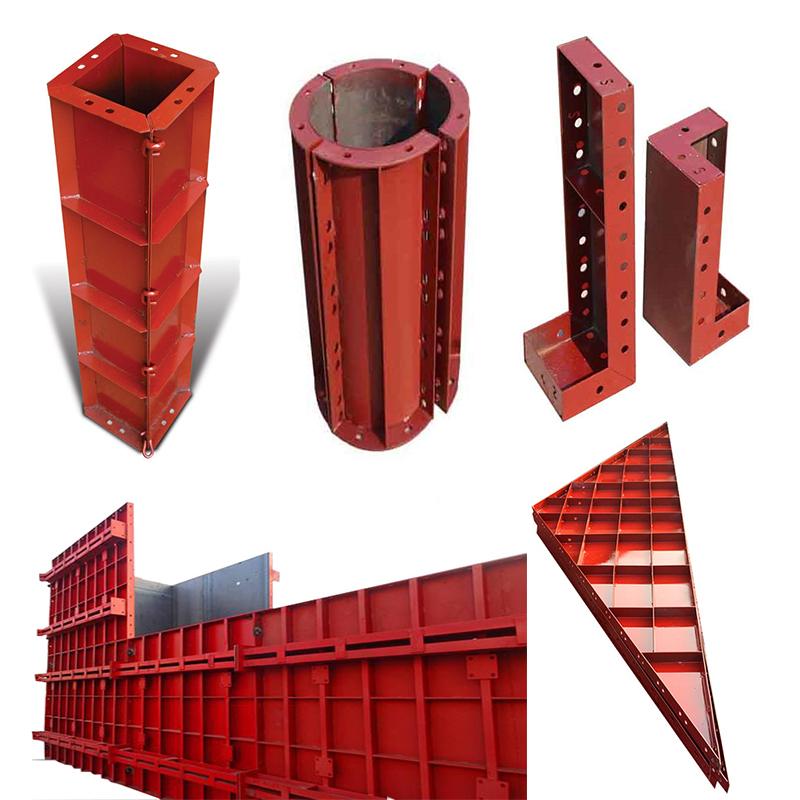
Classified by structural shape: Includes box girder formwork, T-beam formwork, cap beam formwork, pier and column formwork, circular formwork, and various protective beam formwork, to meet the casting needs of concrete components of different shapes.
Modular steel formwork: Composed of standardized flat formwork, inner corner molds, outer corner molds, and other components, flexibly assembled using U-shaped clips, L-shaped pins, and other connectors.
It is suitable for various cast-in-place reinforced concrete structures such as beams, columns, slabs, and walls.
Steel Formwork Specification
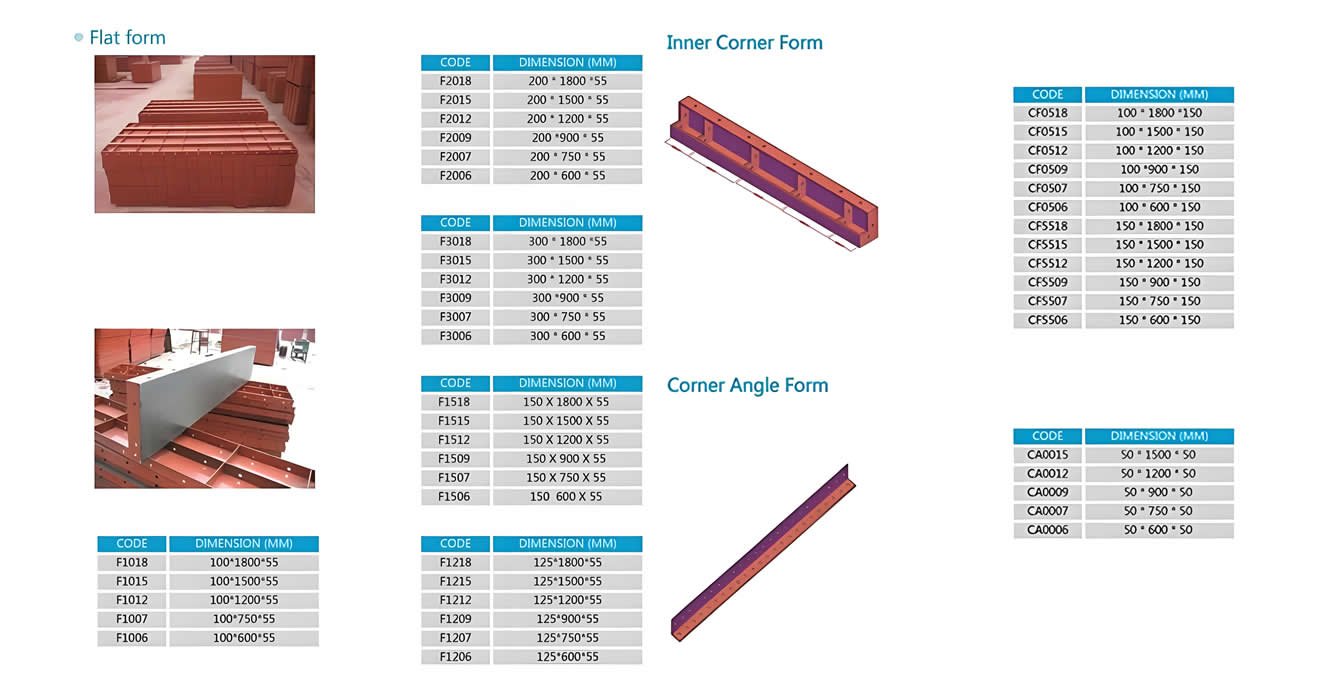
Steel formwork is usually designed using a modular system. The width module increases in increments of 50mm, and the length increases in increments of 150mm, allowing for the assembly of formwork of any size that is a multiple of 50mm in both horizontal and vertical directions. In the design of combined steel formwork, if the modular dimensions do not match the 50mm increment, the gaps can be filled with wooden formwork.
1.1 Length: Available in seven specifications: 450mm, 600mm, 750mm, 900mm, 1200mm, 1500mm, and 1800mm. Width: Available in eleven specifications: 100mm, 150mm, 200mm, 250mm, 300mm, 350mm, 400mm, 450mm, 500mm, 550mm, and 600mm.
Steel Formwork Accessories
An efficient and safe steel formwork system depends not only on the quality of the formwork itself, but also on the correct selection and use of its specialized accessories. Our accessories are designed to facilitate rapid assembly, precise alignment, and stable support of the formwork, thereby improving overall construction efficiency and safety.
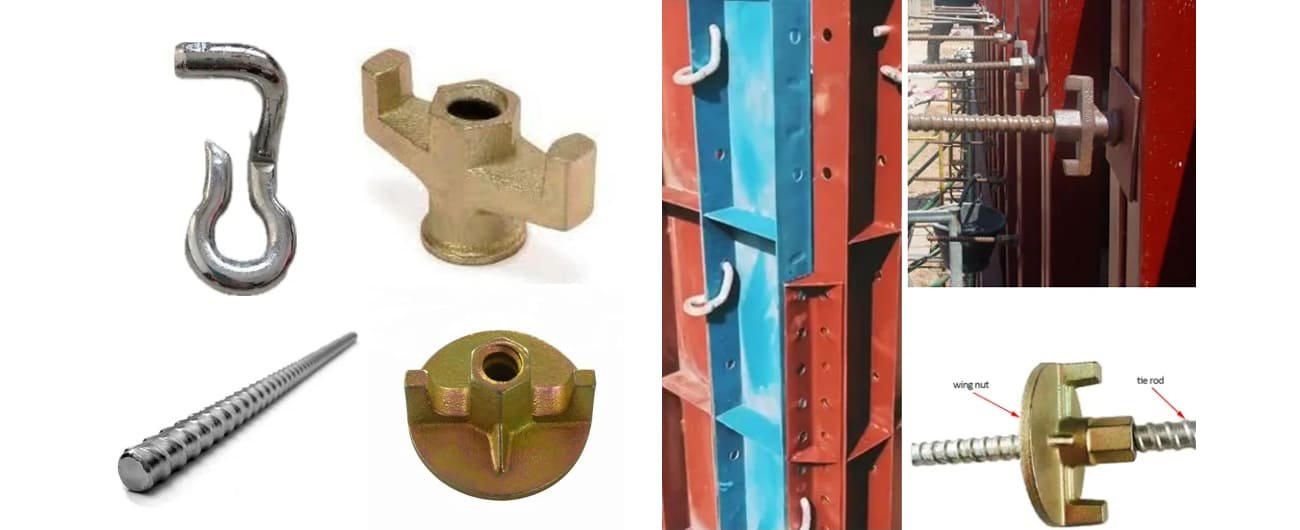
1. U-clip The main connecting component of the formwork, used for assembling adjacent formwork panels.
2. Screw Thread Tie Rod Used to connect formwork panels on both sides of the wall, maintaining the wall thickness, bearing the lateral pressure and horizontal load of the concrete, and preventing the formwork from deforming.
3. Two-wing Nut, together with the screw thread tie rods, form the wall tie rod system, securing the formwork panels during concrete pouring.
Steel Formwork Assembly
Fast Connection, Robust and Stable: Unveiling the Efficient Assembly of Steel Formwork with U-Shaped Clips Want to make the complex assembly of steel formwork as simple and efficient as building with LEGOs?
This video will visually demonstrate the standard operating procedure of the U-shaped clip (U Clip), the core connecting component of the steel formwork system.
You will see firsthand how it enables quick and precise joining of the formwork, ensuring tight and reliable connections every time, resulting in a smooth and even concrete surface.
Steel Formwork Production Process
We strictly adhere to standardized production processes and quality control systems to ensure that every steel formwork panel achieves optimal performance.
Our core processes follow specifications such as the “Technical Regulations for the Processing of Standardized All-Steel Large Formwork.”
Key Production Steps:
1. Design and Cutting
Detailed panel design is based on engineering drawings. High-precision equipment is used to cut and process raw materials such as Q235 steel plates.
2. Assembly and Welding
Panels, edge ribs, and longitudinal and transverse ribs are precisely positioned and assembled on dedicated fixtures. Certified welders use compliant processes to ensure structural strength, with particular attention paid to critical areas such as corners.
3. Correction and Grinding
The welded formwork is inspected and straightened to ensure panel flatness. All welds and burrs are finely ground to ensure a smooth surface.
4. Drilling and Anti-corrosion Treatment
Connection holes are precisely drilled in the panels according to the design. Thorough rust removal is performed, and high-quality anti-rust paint is applied to extend the service life of the formwork in outdoor environments.
5. Final Inspection and Warehousing
A final dimensional check and quality acceptance are performed. Qualified products are marked with specifications and models before being stored in the warehouse for shipment.
Steel Formwork Advantage
By choosing our steel formwork, you will gain the following significant advantages:
1. Excellent Durability and Cost-Effectiveness: Made from high-quality steel, our formwork can be reused over 200 times, far exceeding wooden formwork, significantly reducing the cost per use.
2. Superior Construction Quality: The formwork features tight joints, high overall rigidity and stability, effectively withstanding concrete lateral pressure, preventing deformation, and ensuring accurate concrete dimensions and a smooth, even surface.
3. Efficient Construction Speed: The standardized design supports rapid assembly and disassembly, and combined with overall lifting technology, it can shorten the construction period by approximately 30% compared to traditional wooden formwork, accelerating project progress.
4. Strong Adaptability and Safety: Modular components can be flexibly combined to adapt to various complex engineering structures. The robust steel structure provides enhanced safety on the construction site.
5. Professional Customization Support: We have an independent design department familiar with product requirements in multiple countries, providing a full range of services from design solutions and manufacturing to technical guidance.
We can provide personalized customization based on your specific project needs.
Steel Formwork Application
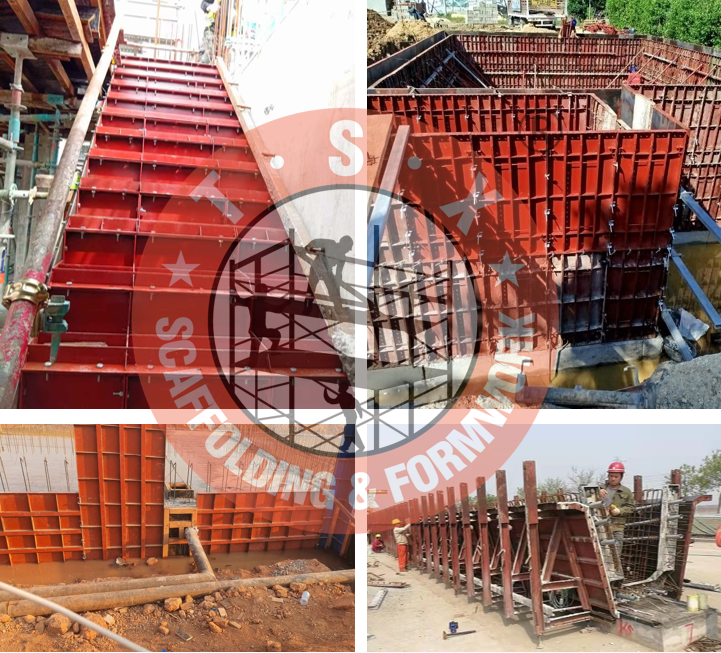
Our steel formwork is widely used in various infrastructure and construction projects worldwide:
- Transportation infrastructure: Bridges, overpasses, cast-in-place box girders, bridge piers, and tunnel linings for high-speed railways and highways.
- Large-scale public and industrial buildings: Hydroelectric dams, port terminals, shear walls and core structures of high-rise buildings, and large factory columns and beams.
- Civil buildings: Standard floor walls of residential buildings, basement retaining walls, and precast formwork for stair treads.
- Other complex structures: Circular piers, water towers, silos, and irregularly shaped landscape components.
Steel Formwork Packing
Steel Formwork Test Report
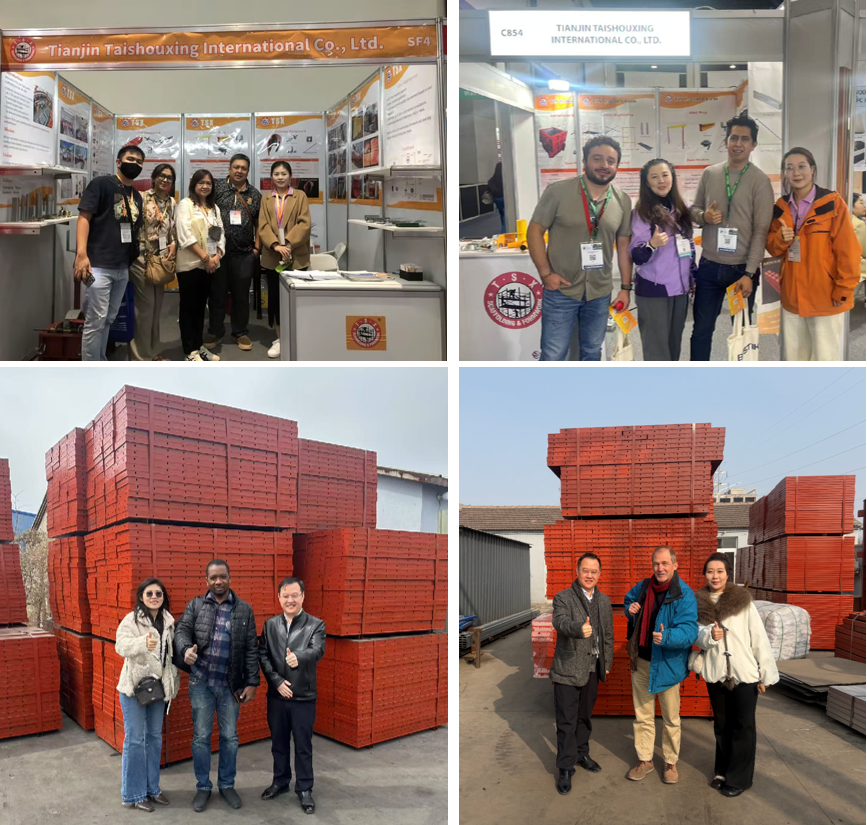
Steel Formwork Exhibition
Steel Formwork FAQ
Q1:What are the main advantages of steel formwork compared to traditional wooden formwork?
A1:The core advantages of steel formwork lie in its exceptionally long service life (up to 200 cycles or more), superior concrete forming quality (smooth surface, precise dimensions), and higher construction efficiency. Although the initial investment is higher, the long-term overall cost is lower, and it is more environmentally friendly.
Q2:What is the typical service life of steel formwork? How should it be maintained?
A2:Under proper use and maintenance, steel formwork can be reused more than 200 times. Key maintenance points include: thoroughly cleaning the surface of cement slurry after each use, inspecting and repairing minor deformations, applying release agent and anti-rust paint before and after storage, and avoiding prolonged exposure to sunlight and rain.
Q3:Can you provide custom-sized or specially shaped formwork?
A3:Yes. Customization is one of our core strengths. We have a professional design team that can produce various irregular formwork, such as curved wall formwork and special node formwork, based on your engineering drawings or specific requirements.
Q4: What precautions should be taken during the transportation and on-site storage of formwork?
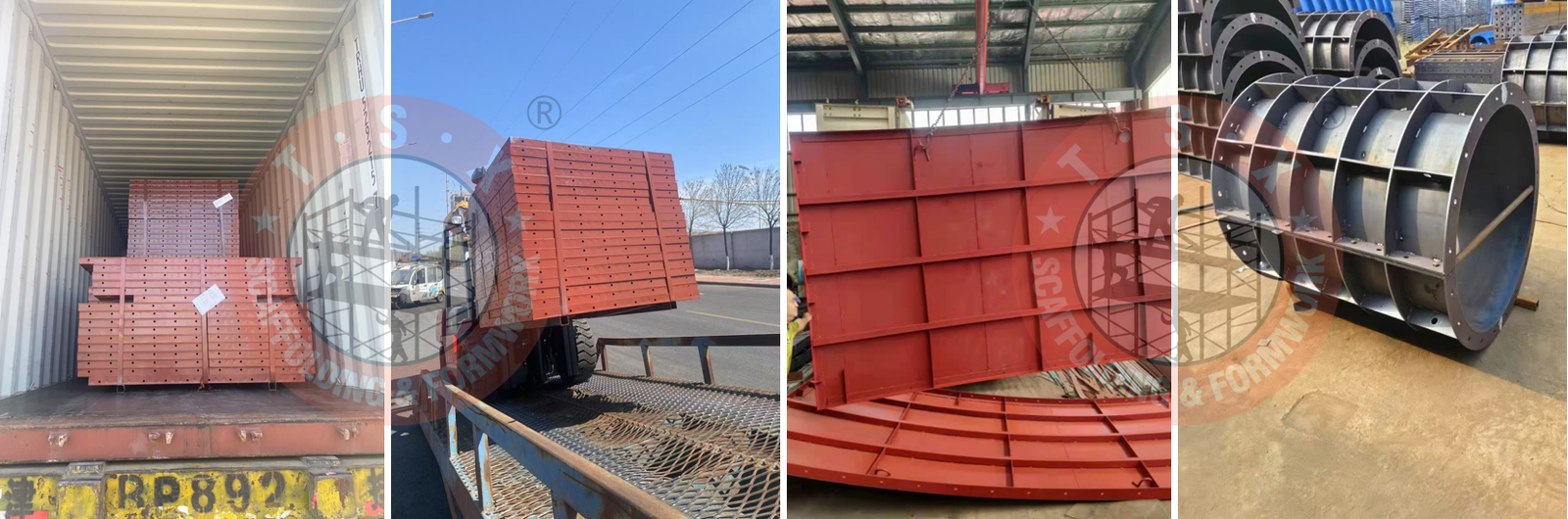
A4:During transportation, the formwork should be securely bundled with ropes or steel straps to prevent damage from bumps and friction. On-site storage should be in a flat, well-drained area, elevated from the ground to avoid contact with soil. For long-term outdoor storage, it is recommended to cover the formwork with waterproof tarpaulin.
Q5:Do your products comply with international standards? Can you provide quality certifications?
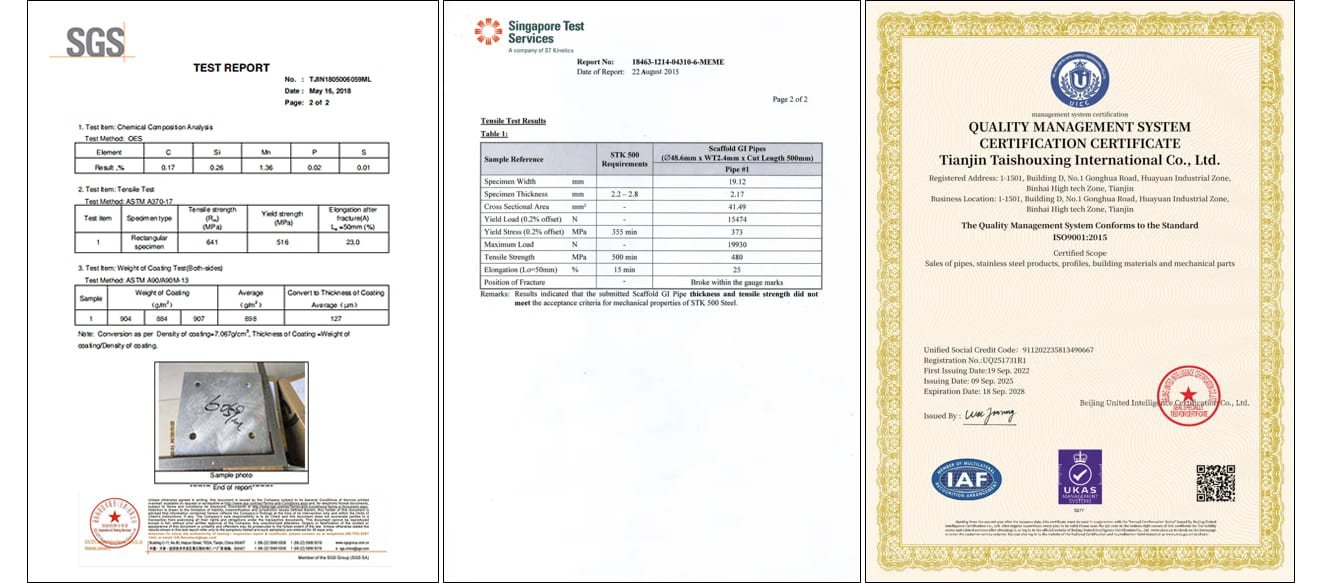
A5:Our production strictly follows relevant national and industry technical specifications (such as SS580), and we can design and manufacture according to international standards upon customer request. We can provide material certificates, certificates of conformity, and third-party testing reports for our products.
Q6:Do your products comply with international standards? Can you provide quality certifications?
A6:Our products sell well all over the world, but Europe and South America are the most popular markets. Among them, Britain, France, Australia, the United States and other countries have long-term cooperation.
Q7:How you can control your quality?
A7:inspection department to ensure that every step is inspected by a dedicated person, and any problem at any step can be traced to the source, reducing the time to deal with after-sales problems.
Q8:What about your payment terms?
A8:Our payment terms are the first 30%, the last 70%, support TT, Credit card, Western Union, L/C, Credit Insurance, if you need other payment methods, please contact us.
Regarding currencies, we support currencies in more than 30 countries. The conventional currencies are USD, SGD, GBP and RMB.
Q9:What about the freight charge?
A9:We have a special freight forwarder quotation.
The FOB cost includes the cost of the factory to the port, customs declaration and port miscellaneous.
The CIF fee includes the FOB fee and the fee for sending from Tianjin Port to your port. We support you to find a freight forwarder locally, before shipping, both parties compare the price of ocean freight.
Q10:Can you make samples according to my requirements? How long does it take to make a sample?
A10:No problem at all. Please provide drawings or detailed parameters.
According to experience, it usually takes 1-2 weeks. According to the complexity of the product, such as laser cutting, special treatment, etc.